
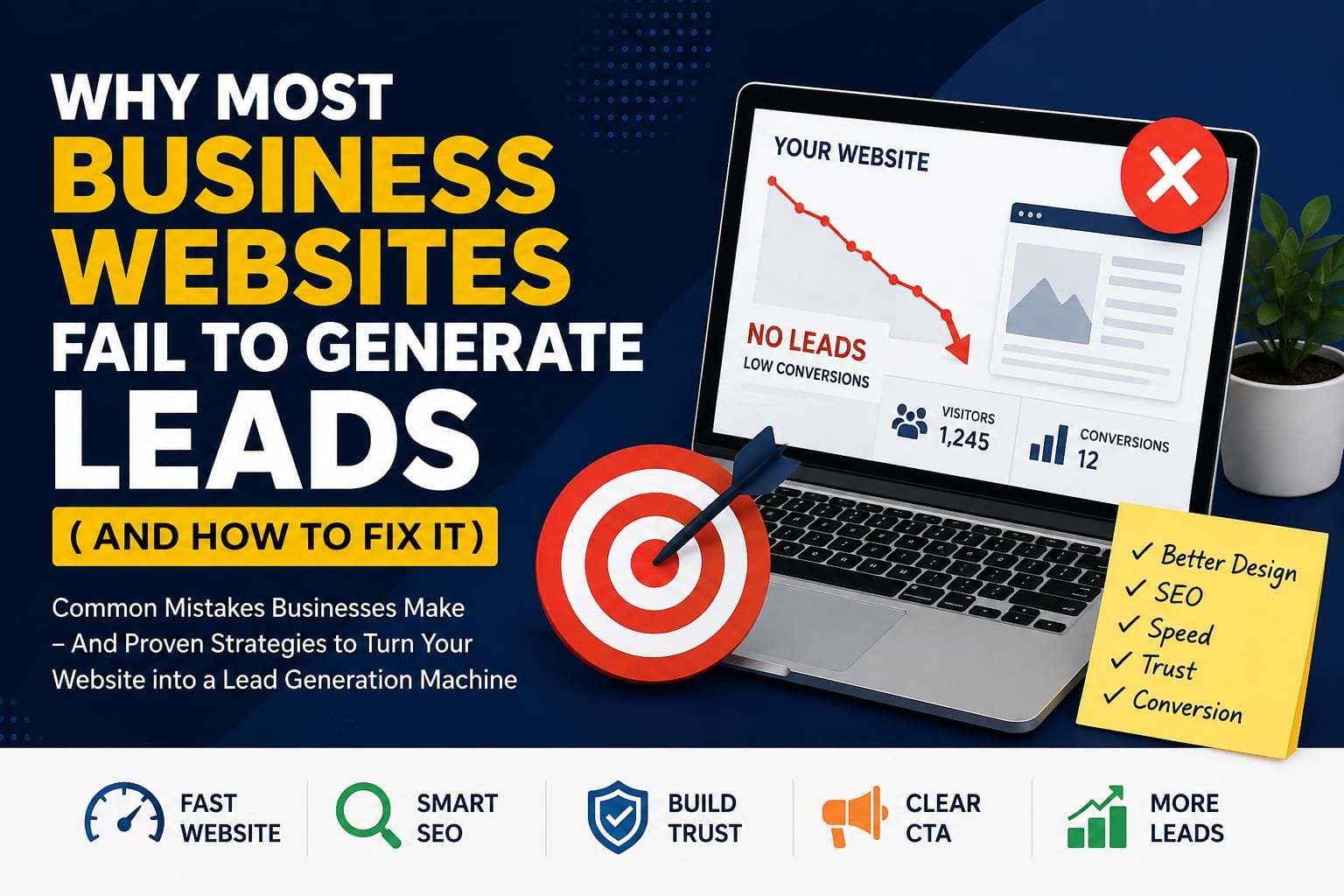
Why Most Business Websites Fail to Generate Leads (And How to Fix It)
Every year, thousands of businesses invest in websites hoping to get more customers, increase sales, and build a stronger online presence. Unfortunately, most business websites fail to achieve these goals.
Many business owners believe that simply having a website is enough. The reality is different. A website is not a digital brochure. It should work as a sales and lead generation machine.
In this article, we will explore the most common reasons why business websites fail to generate leads and what businesses can do to improve their results.
1. Poor User Experience
The first impression matters.
When visitors land on a website that is slow, confusing, or difficult to navigate, they leave within seconds. Many websites lose potential customers simply because users cannot find the information they need.
A successful business website should have:
- Clear navigation
- Fast loading speed
- Mobile-friendly design
- Easy-to-find contact information
- Professional layout
Businesses should focus on simplicity rather than unnecessary design elements.
2. No Clear Call-to-Action
Many websites provide information but never tell visitors what to do next.
A visitor may be interested in your services but if there is no clear action available, they leave without contacting you.
Effective calls-to-action include:
- Request a Free Consultation
- Get a Quote
- Schedule a Call
- Contact Us Today
- Start Your Project
Every important page should guide visitors toward the next step.
3. Slow Website Speed
Website speed directly affects user experience and search rankings.
Research consistently shows that users abandon slow websites quickly. A delay of even a few seconds can reduce conversions significantly.
Common reasons for slow websites include:
- Large image files
- Poor hosting
- Unoptimized code
- Too many plugins
Speed optimization should be a priority for every business website.
4. Lack of Search Engine Optimization
A website that cannot be found on Google cannot generate consistent leads.
Many business websites are launched without proper SEO planning. As a result, they receive little or no organic traffic.
Important SEO factors include:
- Keyword research
- Optimized page titles
- Meta descriptions
- Internal linking
- Quality content
- Local SEO optimization
Businesses targeting local customers should also optimize their Google Business Profile.
5. No Trust Signals
Visitors need confidence before contacting a company.
Trust signals help businesses establish credibility and improve conversion rates.
Examples include:
- Client testimonials
- Google reviews
- Case studies
- Project portfolio
- Company information
- Contact details
A website without trust signals often struggles to convert visitors into customers.
6. Outdated Design and Content
An outdated website creates a negative impression.
Visitors often judge a company's professionalism based on its website. If the content is outdated or the design looks old, potential customers may choose competitors instead.
Regular updates improve both user experience and search engine visibility.
7. Ignoring Mobile Users
Most website traffic now comes from mobile devices.
A website that performs poorly on smartphones loses a significant portion of potential customers.
Mobile responsiveness is no longer optional. It is a basic requirement for business growth.
How to Build a Website That Generates Leads
Businesses should focus on three key objectives:
- Attract visitors through SEO.
- Build trust through professional design and social proof.
- Convert visitors through strong calls-to-action.
A successful website is not just about appearance. It should support business growth, lead generation, and customer engagement.
Final Thoughts
A website should be one of the most valuable assets for any business. However, many companies fail to achieve results because they focus only on design and ignore user experience, SEO, speed, trust, and conversion optimization.
Businesses that invest in a strategic website approach are more likely to attract qualified leads, improve customer engagement, and achieve long-term growth.
If your website is not generating leads, now is the right time to identify the gaps and implement the necessary improvements.
Senior team of web developers, SEO strategists and digital marketers at Yuriva Web Technologies. We write about what we build — real experience from 200+ projects.
About the Team →